

Most people focus on tools. They look for the latest software, the newest productivity hack, or a faster way to do the wrong things. They operate at the surface level, ignoring the structural layers that actually generate power.
The Sovereign Strategy Stack is a tiered architecture for leading the board. It is based on a single, brutal law: Inside Outside. You must upgrade your thinking before you upgrade your tools.
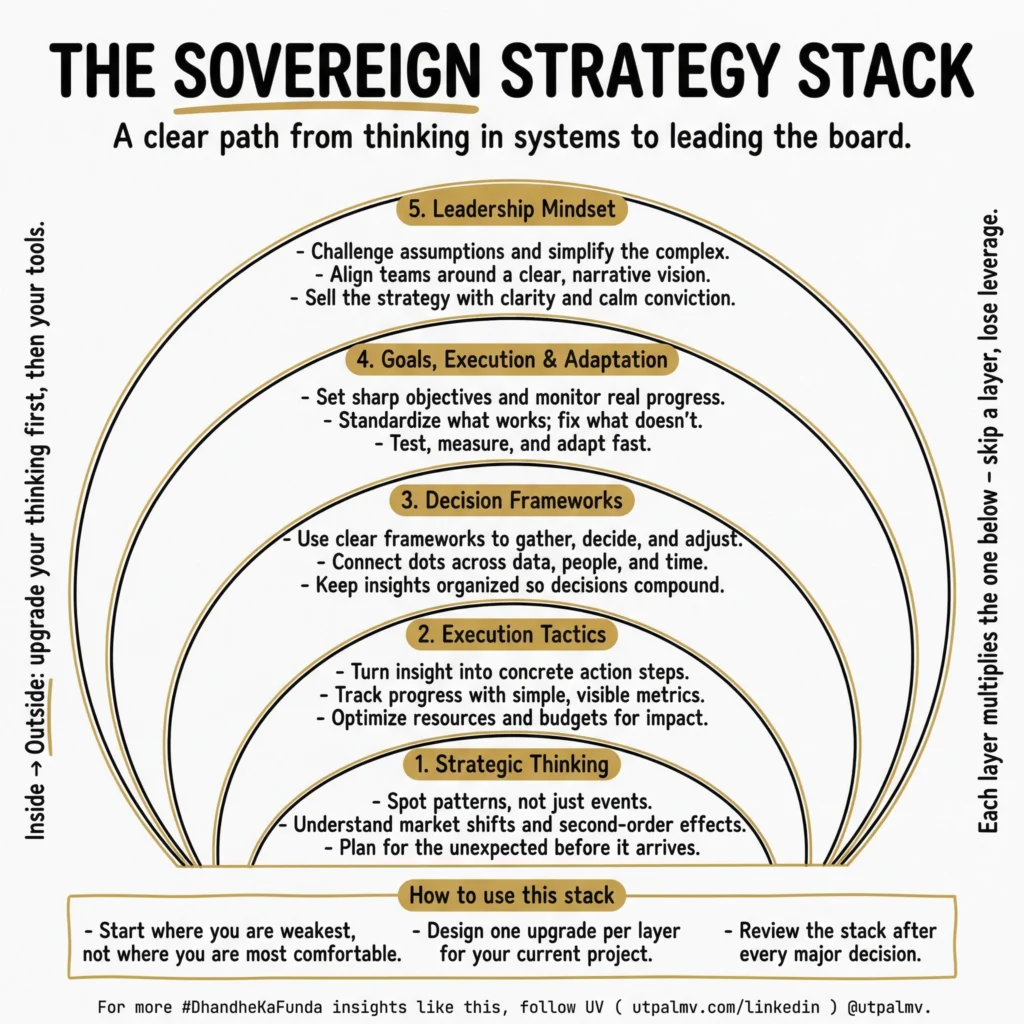
The Architecture of the Stack
The stack is a concentric system where each layer multiplies the effectiveness of the layer beneath it. If you skip a layer, you lose leverage.
Layer I: Strategic Thinking (The Foundation)
This is the innermost core. It is the ability to spot patterns, not just events.
-
The Focus: Understanding second-order effects and planning for the unexpected before it arrives.
-
The Architect Move: Shift from reacting to market shifts to anticipating them by deconstructing the underlying system.
Layer II: Execution Tactics (The Action)
Tactics convert strategic insight into concrete movement.
-
The Focus: Tracking progress with simple, visible metrics and optimizing resources for maximum impact.
-
The Architect Move: Do not confuse “busy-ness” with execution. If the tactic doesn’t serve the strategic pattern, it is waste.
Layer III: Decision Frameworks (The Filter)
Frameworks allow you to gather data, decide, and adjust without cognitive fatigue.
-
The Focus: Connecting dots across data, people, and time so that insights compound.
-
The Architect Move: Build an external brain. Keep insights organized so that every decision makes the next one easier.
Layer IV: Goals, Execution & Adaptation (The Loop)
This layer monitors real progress and standardizes what works.
-
The Focus: Setting sharp objectives and testing, measuring, and adapting with high velocity.
-
The Architect Move: Standardize the successful moves; ruthlessly fix or discard the failures.
Layer V: Leadership Mindset (The Authority)
The outermost layer is where the strategy meets the world. It is about alignment and conviction.
-
The Focus: Challenging assumptions and aligning teams around a clear, narrative vision.
-
The Architect Move: Sell the strategy with calm conviction. Simplify the complex so the federation moves as one.
The Multiplier Law
The effectiveness of your leadership is not a linear sum; it is a product of these layers.
Inside Outside: If your strategic thinking is zero, your leadership mindset is just noise. If your decision frameworks are broken, your execution is just high-speed aimlessness.
The Strategy Audit :: Debugging the Stack
When a project stalls or a venture fails, the Architect does not look for new tools; they audit the stack.
How to Use this Stack
-
Identify the Weakest Layer: Do not start where you are comfortable. Audit the stack and find the layer that is currently leaking the most leverage.
-
Design One Upgrade: Choose one specific upgrade for that layer (e.g., a new Decision Framework or a sharper Goal-setting loop).
-
Review Post-Move: After every major decision or board move, review the stack to see which layer failed or succeeded.
The goal is not to have more tools. The goal is to lead the board from the inside out.