

A Systems Thinking Protocol for Architects, Systems, and Federations
(Last revised: May 2026 | Status: Living Document)
~~~
The Premise
Most performance frameworks are built for employees. They optimize for output within a given system. They assume the system itself is fixed.
MSDx is built for Architects. People who intend to design the system, not just operate inside it.
The difference is not ambition. It is resolution. An Architect asks not “how do I perform better” but “what is the architecture producing these results, and how do I change it?”
MSDx gives you the diagnostic language to answer that question. At any scale.
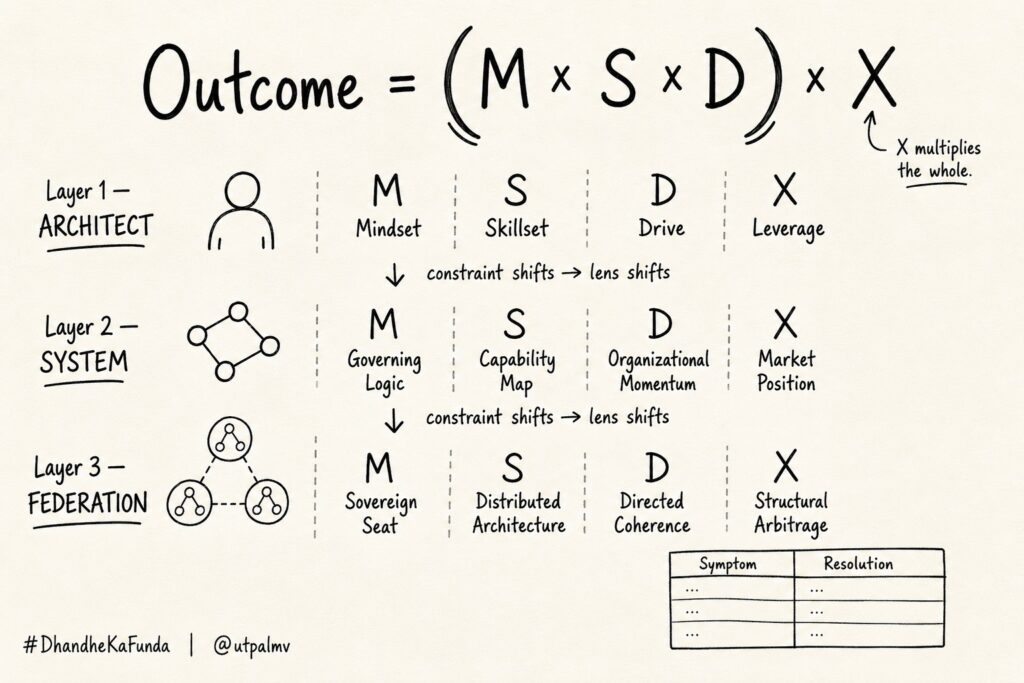
The Equation
Outcome = (M x S x D) x X
Four variables. One multiplicative relationship.
M is Mindset. S is Skillset. D is Drive. X is Leverage.
The multiplication is not a metaphor. It is structural. A zero in any variable collapses the entire output. High Drive with no Leverage produces linear results. High Leverage with no Drive produces noise. The variables are interdependent, not additive.
X sits outside the parentheses for a reason. It is not a fourth input alongside M, S, and D. It is the force that determines the scale at which those three variables operate. The same unit of (M x S x D) produces radically different outcomes depending on the Leverage attached to it.
This is the Architect’s primary question before any move: which Leverage is attached to this action?
The Operating Environment: 2026
MSDx does not exist in a vacuum. The framework runs inside an operating environment that changes the absolute value of every variable.
In 2026, that environment has three defining characteristics:
Strategy-First. The volume of available tools, capital pathways, and market signals has reached a level where undirected action is more dangerous than inaction. The Architect who moves without a clear strategic thesis is not bold. They are expensive.
AI-Native. AI is not a tool inside the Leverage variable. It is a structural shift that simultaneously changes the ceiling for every variable. An AI-native Mindset processes information differently. An AI-native Skillset executes at a speed and breadth previously requiring teams. AI-native Leverage compounds faster than any prior technological multiplier. MSDx in 2026 assumes AI-native operation as the baseline, not the exception.
Interdependent. No Architect of consequence operates alone. The outcomes that matter are produced through nodes — people, organizations, and capital structures — in relationship with one another. Independence is a starting condition. Interdependence is the operating state of the Sovereign Architect.
These three are not values to aspire to. They are the physics of the current environment. MSDx operates inside them.
The Polymorphic Principle
MSDx is a Systems Thinking protocol. Its atomic unit changes depending on the resolution at which you apply it.
Resolution 1: The Architect. The individual is the unit. M, S, D, and X describe a single person’s capability architecture.
Resolution 2: The System. The organization, company, or venture as the unit. M, S, D, and X describe how the system thinks, executes, sustains energy, and multiplies output.
Resolution 3: The Federation. A system of systems is the unit. Multiple nodes — companies, teams, capital structures — governed by a Sovereign Architect. M, S, D, and X describe the federation’s governing philosophy, distributed capabilities, collective coherence, and structural arbitrage.
The equation does not change across resolutions. The subject of the equation does.
This matters because most performance failures are misdiagnosed at the wrong resolution. An Architect who is performing well as an individual may be producing a System with a broken Drive architecture. A System that is executing well may be operating inside a Federation with no governing Mindset at the top. The repair move is completely different depending on where the failure actually lives.
The Variables
M :: Mindset: The Governing Logic
Mindset is the cognitive operating system of the unit being examined.
At Architect resolution, it is how an individual processes signals, risk, and opportunity. The difference between reading a market contraction as a survival threat or a structural entry point is a Mindset variable. It determines which game the Architect thinks they are playing.
Sovereign Mindset traits: Agency over circumstance. Long-range orientation. Reality-grounding over narrative comfort. Systems Thinking — the capacity to see relationships, feedback loops, and second-order effects rather than isolated events.
The Architect Move: You do not find a mindset. You architect one. Deliberately. By choosing which inputs to expose yourself to, which beliefs to pressure-test, and which cognitive defaults to override.
At System resolution, Mindset is organizational culture and decision architecture. How does the company interpret market signals? What does it consider a win? What does it never question? A System’s Mindset is visible in its meeting rhythms, its hiring decisions, and what gets celebrated versus what gets quietly buried.
At Federation resolution, Mindset is the governing philosophy across all nodes. The Sovereign Architect’s mental model of how the system of systems should allocate resources, resolve conflict, and set direction. If this seat is vacant — if no one is operating at Federation resolution — the federation defaults to whichever node is loudest that quarter. That is not governance. That is drift.
S :: Skillset: The Capability Stack
Skillset is the conversion of intent into technical leverage. Ideas without capability produce noise.
At Architect resolution, the priority is transferable, high-resolution skills. Capital Allocation — the ability to direct resources toward asymmetric returns. Communication — the ability to move people, not just inform them. Systems Design — the ability to build structures that produce outcomes without requiring constant personal intervention.
The Architect Move: Sharpen the tools you use to design the board. Not just play the move.
At System resolution, Skillset is the organization’s capability map. What can the system build, sell, and sustain without the founder’s direct involvement? The moment a System’s capability becomes inseparable from a single person, it is no longer a System. It is a freelancer with employees.
At Federation resolution, Skillset is a distributed capability architecture. Which node does what? How capabilities are shared, transferred, or replicated across the federation without losing fidelity. The Federation Skillset question is not “what can we do” but “where does each capability live, and can it move?”
D :: Drive: The Coherence Architecture
Drive is the sustained energy applied to the system. In v1, Drive was defined as metabolic energy and clinical consistency. Both remain true at the Architect level. But Drive at higher resolutions is something different in kind.
At Architect resolution, Drive is the clinical consistency required to see a system through to its logical conclusion. Not motivation — motivation is an emotion. Drive is a resource. It is managed, not chased. The Architect who treats Drive as a feeling will run out of it. The Architect who treats it as infrastructure will sustain it.
At System resolution, Drive is organizational momentum. The culture of execution. Speed of iteration. The institutional will to complete what was started. A System with high individual talent but low organizational Drive produces brilliant abandoned projects.
At the Federation resolution, Drive is precise: Directed Coherence.
Individual Drive across nodes is not enough. Each node can have high Drive and still produce net-zero collective displacement. This happens when the energy vectors are scattered — each node moving with a different intensity in different directions. The federation looks busy. It goes nowhere.
Directed Coherence is the alignment of distributed energy toward a shared vector, maintained through incentive architecture rather than motivation. The Architect does not inspire the federation into alignment. They design the structures that make alignment the path of least resistance.
The Leaders Fund is one implementation of Directed Coherence: each leader gains primary benefit from their own node and secondary benefit from all others. Individual Drive becomes federation-aligned not through culture decks or all-hands meetings, but through the geometry of incentives. Teams start talking. Problems get solved across nodes. Things ship.
The Federation Drive diagnostic question: Are the Drives of my nodes additive or canceling?
If canceling, the repair move is always architectural. Redesign the incentive geometry before addressing individual motivation.
X :: Leverage: The Force Multiplier
Leverage is what determines the scale at which (M x S x D) operates.
The Architect’s primary question before any action: which Leverage is attached to this move?
Without Leverage, effort is linear and time-bound. The same unit of effort, with the right Leverage attached, produces 10x or 100x the outcome. This is not luck. It is physics.
Forms of Leverage:
Capital. Financial resources that work while you sleep. The Architect deploys capital; the Operator earns income.
Network. Relationships that open doors, surface opportunities, and compress trust-building cycles. Network Leverage is asymmetric — one strong node can unlock an entire new operating environment.
Reputation. The accumulated signal of past performance. Reputation reduces friction in every transaction. It is the form of Leverage that compounds the longest and is hardest to replicate.
Asymmetry. Structural information or timing advantages. Knowing something the market does not yet price. Being positioned for a transition before consensus forms. This is the Leverage that produces the largest multiples and is the least discussed.
At System resolution, Leverage is market position, proprietary distribution, brand, and technology infrastructure. What can this system do that competitors cannot easily copy?
At Federation resolution, Leverage is structural arbitrage. The Federation wins by accessing advantages unavailable to any single node — cross-jurisdictional capital structures, cross-network relationships, cross-talent pools, and regulatory positioning. A Federation’s Leverage is not the sum of its nodes’ individual Leverage. It is the emergent Leverage that only exists because the nodes are in a relationship.
The Diagnostic
The Sovereign Architect does not blame circumstance for poor outcomes. They audit the architecture.
First question: at which resolution is the failure occurring?
Is this a failure of the individual Architect? The System? The Federation?
Diagnosing a Federation-level failure at the Architect level results in useless repair attempts. Diagnosing an Architect-level failure at Federation resolution wastes structural energy on a personal problem.
Once the resolution is identified:
| Symptom | Resolution | Probable Failure | Repair Direction |
|---|---|---|---|
| Motion without progress | Any | Mindset misalignment | Audit the compass. What game does the unit think it is playing? |
| High effort, low output | Any | Skillset gap | Wrong tools for the task. Identify the missing capability precisely. |
| Stalled momentum | Architect / System | Drive depletion | Restore the resource. Remove the drain before adding more fuel. |
| Scattered activity, low collective output | Federation | Drive scatter / No Directed Coherence | Redesign incentive geometry. Do not address motivation first. |
| Linear results despite high activity | Any | Leverage absence | Identify which Leverage is missing. Attach it before increasing effort. |
| Misaligned nodes | Federation | Sovereign Seat vacant | Someone must operate at Federation resolution. If no one is, that is the first repair. |
| Unfinished cycles | System / Federation | Execution breakdown | Audit the delivery mechanism: decision speed, iteration loops, cross-node alignment. |
The Lens Transition
A critical diagnostic question the framework makes possible: have I outgrown my current operating resolution?
The lens shifts when the binding constraint is no longer internal to the current unit.
When the individual Architect is no longer the ceiling on outcomes — when the system is the constraint — shift to System resolution. The bottleneck is now organizational.
When the single System is no longer the ceiling — when the structure of multiple nodes is the constraint — shift to Federation resolution. The bottleneck is now architectural: jurisdictional, capital-structural, or network-topological.
Most Architects resist this shift. It requires letting go of the operating level where they are most skilled and most comfortable. The founder who was the best executor in the company, must become the worst executor in the federation — because their job is no longer execution at the node level. It is governance at the Federation level.
This transition is not a reward. It is a responsibility. And it requires a different Mindset, a different Skillset, a different application of Drive, and a different class of Leverage than the level below it.
The Audit Rhythm
MSDx is a living diagnostic, not a one-time read.
Quarterly audit questions for each resolution:
Architect Resolution
- Which of M, S, D is the current binding constraint on my output?
- What Leverage is attached to my three highest-effort activities?
- Is my Mindset calibrated to the current environment or a prior one?
- Where am I operating out of habit rather than architecture?
System Resolution
- Can this System operate for 90 days without my direct involvement?
- Where is the Drive concentrated in one person rather than built into the structure?
- What capability does the System lack that is currently being patched by individual heroics?
- Which Leverage is the System not using that it could?
Federation Resolution
- Is the Sovereign Seat occupied? Am I actually operating at Federation resolution, or am I dropping into node-level management?
- Are the Drives of my nodes additive or canceling? What does the incentive geometry produce?
- Which Federation-level Leverage exists that no single node can access alone?
- Where is the Federation’s Mindset — its governing philosophy — unclear or absent?
MSDx for Systems
MSDx at System and Federation resolution is a separate and developing body of work. As the framework is applied across organizations, portfolios, and multi-entity structures, the System and Federation protocols will be documented here.
The core equation holds at every resolution. The variable definitions evolve with the application.
→ MSDx for Systems: In development.
→ MSDx for Federations: In development.
~~~
The Architect who cannot diagnose their own architecture cannot govern anyone else’s.
#DhandheKaFunda: The move that looks like effort from the outside is always Leverage from the inside.